Jul 26, 2018

Jul 7, 2017
Afternoon on a Hill
I will be the gladdest thing
Under the sun!
I will touch a hundred flowers
And not pick one.
I will look at cliffs and clouds
With quiet eyes,
Watch the wind bow down the grass,
And the grass rise.
And when lights begin to show
Up from the town,
I will mark which must be mine,
And then start down!
Edna St. Vincent Millay
Under the sun!
I will touch a hundred flowers
And not pick one.
I will look at cliffs and clouds
With quiet eyes,
Watch the wind bow down the grass,
And the grass rise.
And when lights begin to show
Up from the town,
I will mark which must be mine,
And then start down!
Edna St. Vincent Millay
Feb 7, 2017
Quote
“In the depths of every heart there is a tomb and a dungeon, though the lights, the music, and the revelry above may cause us to forget their existence...”
― Nathaniel Hawthorne
― Nathaniel Hawthorne
Jan 23, 2017
The Widow
 “We are not idealized wild things.
We are imperfect mortal beings, aware of that mortality even as we push it away, failed by our very complication, so wired that when we mourn our losses we also mourn, for better or for worse, ourselves. As we were. As we are no longer. As we will one day not be at all.”
― Joan Didion, The Year of Magical Thinking
I have become a "widow" and am in mourning, for all that I was and all that I will never be. I have lost my husband in a sea of memories, tears, and tomorrows yet to come. I reach out for my own hand and cannot find it. Something shadowed has replaced me, a stranger struggling with illness and confusion, and minutes and hours and days alone, a kind of loneliness that has no solid definition.--Jane
Nov 20, 2016

Nov 9, 2016
Moving On
"[O]ne of the chief errors of thought is to continue to think in one set of forms, categories, ideas, etc., when the object, the content, has moved on, has created or laid premises for an extension, a development of thought."
CLR James, Notes on Dialectics.
Oct 18, 2016
Quote for Sleeping Beauty Retelling
And I've never loved a darker blue
Than the darkness I've known in you;
Owned from you.
You whose heart would sing of anarchy.
You who’d laugh at meanings, guarantees, so beautifully
When our truth is burned from history
By those who’ve figured justice in fond memory.
Witness me
Like fire weeping from a Cedar tree.
Knowing that my love would burn with me
We'll live eternally
Lyrics from Better Love by Hozier
( I don't often post quotes that reveal too much about my work, but when I saw this, it reminded me of a scene between the heroine and the hero of my book. It's something "She" would say to "Him" near the end of the story.)
( I don't often post quotes that reveal too much about my work, but when I saw this, it reminded me of a scene between the heroine and the hero of my book. It's something "She" would say to "Him" near the end of the story.)
Oct 15, 2016
Oct 14, 2016
Sep 22, 2016
Sep 20, 2016
Sep 17, 2016
A Review of Black Spring by Alison Croggon
 Black Spring by Alison Croggon
My rating: 5 of 5 stars
Okay, here's my thoughts on Black Spring:
First as a retelling of Wuthering Heights
Wuthering Heights is a metaphysical novel, what some call Visionary Fiction. Yes, it's Gothic and from the latter English Romantic Period, but it's the sort of novel that people read and think about in terms of exactly what it is and what it is about. Part love story, part fairy tale, part revenge tale, it's the kind of novel that one can never quite place in the natural scheme of literary things. It just doesn't fit. How Emily Bronte wrote it is still a mystery to me. I've always wanted to write a retelling, but never been brave enough and after reading Black Spring, I am even more fearful. Laughing.
Black Spring is clearly the author's love letter to Emily Bronte and Wuthering Heights. In fact, the author states this. But even without that statement, I can see it. Like others, I've always considered Wuthering Heights a sort of tribute to Milton's Paradise Lost. If you have never read that, it's hard to fully grasp Bronte's story.
The idea is that the lovers fall from Hell into Heaven. (Maybe we all do) Talk about subverting Milton's trope! And it's so feminist. Well, I don't want to go on and on about that, but in Black Spring, we have the true Catherine character in the outcast and exiled Lina, who is a witch, doomed to be feared and under a death threat her entire life. As she develops into a woman, the changes she feels are like those of the characters in Wuthering Heights, for she is falling from Hell to a Heaven when she meets Damek. Together they kind of make a whole, both cruel and wild, aligned with nature. They don't belong anywhere, but to each other. Talk about a love story that is more than a love story.
Why does Lina (and Catherine) forsake their true lovers and move toward a direction of pure tragedy that can only be obliterated by their deaths??????
Well, that is the ultimate question. And Black Spring does it so well, by making sure that Lina, like Catherine, is searching for a way out of her patriarchal world. Of course, it doesn't really work.
Both Damek and Heathcliff (mirrors of Lina and Catherine) want to possess their lovers completely. The two ladies really have no choices. Lina will always be a witch. She will never be the normal, docile wife that her husband wants, she will never love anything or anyone but her mirror self. She and Damek are both imprisoned in their roles. And this imprisonment leads to madness.
In Wuthering Heights, Catherine starved herself; in Black Spring, Lina refused to heal from childbirth and accept her new role as wife and mother.
Of course Damek is not whole without his other half, and so he self destructs. All this is done so well in a new story.
Black Spring as a Fantasy Novel
SPOILERS!!!!! But it really doesn't spoil, because you have to read it to appreciate it.
Although I love all the parallels to Wuthering Heights, I absolutely loved this Gothic gem about a place ruled by a law called The Vendetta, a curse so powerful it gave me the chills when I thought about what it really meant.
Croggen invented a whole new mythology, one that I have never seen in previous YA novels. I made a note in the book that this vendetta was worse than anything Shirley Jackson wrote in her stories!
It's about a law that exists in the North lands, where if one man of a family is killed by a man from another family (all noble people are exempt), the nearest relative of the dead man must kill the murderer, and then the opposite and nearest family member must exact revenge against the latter, and the revenge goes on and on forever, until all family members of both families are dead. (Sometimes there is a truce formed by the Wizards of the North). (Note: Women don't matter! They are only property and mothers and servants.)
It's ghastly. The money these people must pay in a Blood Tax for each single death is given to the King, sometimes, all possessions, houses, and lands are used. Therefore, the entire landscape of the North is dotted with tombstones and graveyards. A single Vendetta can go on for years and years, even a century!
This was pretty brilliant in my opinion. There are metaphysical and social questions about such a system, placed upon the ordinary people by their King and nobility. It's a system built on extreme HONOR but at what price? I was completely fascinated by this whole system and it sparked a lot of creative thinking for me as a reader and writer.
The writing is awesome if sometimes difficult. The author paid a special tribute to Bronte by incorporating language of Bronte and even mimicking the power and themes of the Gondal poems, which are the basis for Wuthering Heights. But I loved all that. There are some powerful passages. I ended up marking the entire book. Laughing.
Finally....
One particular passage was so haunting. It is when the opening narrator is riding through the landscape of the North and he looks out his carriage and sees a lone young man walking down the road, a young man who escaped The Vendetta by living only in the open at night and making his home in the day in what the author called an odu. This young corpse of a man was fated never to see sunlight again, almost like a vampire. It was utterly creepy and I don't think I will ever forget that image and am bound to use some form of it in my own writing later on. It was only two paragraphs, but so powerful.
And I found myself thinking of its connection to Wuthering Heights in other ways and I am not even sure the author intended that. Those are my own secret thoughts. I am still thinking about it.
View all my reviews
Aug 17, 2016
Jun 1, 2016

May 31, 2016
Bee balm

Bee balm, any variety, is one of my favorite plants for the garden. It's whimsical and wild.
May 30, 2016
Maze
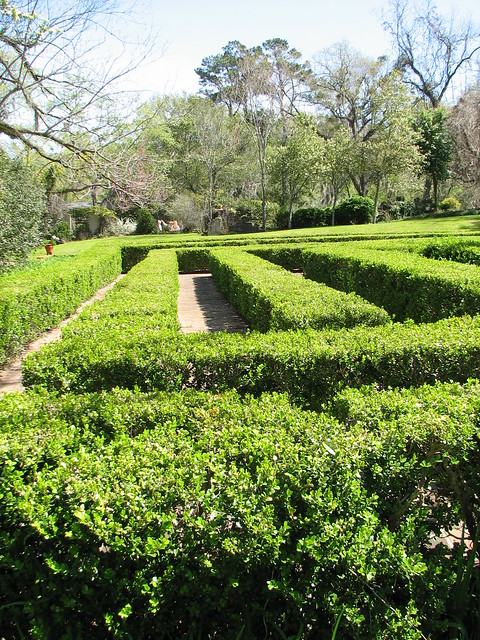
Real obstacles don't take you in circles. They can be overcome. Invented ones are like a maze. --
Barbara Sher
May 29, 2016
Shiloh
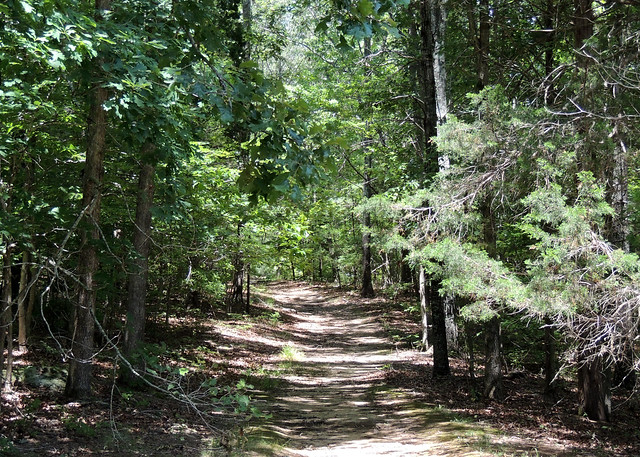
John and I drove over to Shiloh last Thursday (May 26). It's a beautiful park, so peaceful and green. Difficult to see it as probably a defining moment in the American Civil War. Shiloh, by the way, means peace.
May 12, 2016
Apr 13, 2016
On Dolls
I've always had an uneasy relationship with dolls, which is not rare. Dolls conjure The Uncanny, (more on this later) that allows for a kind of anxiety few of us want to discuss.

According to Kenneth Gross: “The puppet creates delight and fear. It may evoke the innocent play of childhood, or become a tool of ritual magic, able to negotiate with ghosts and gods. Puppets can be creepy things, secretive, inanimate while also full of spirit, alive with gesture and voice.” I've always felt the same way about many dolls. Once, when a child, I tore the arms off a doll because I was afraid of it. I felt safe. Without hands, the doll could not touch me.

According to Kenneth Gross: “The puppet creates delight and fear. It may evoke the innocent play of childhood, or become a tool of ritual magic, able to negotiate with ghosts and gods. Puppets can be creepy things, secretive, inanimate while also full of spirit, alive with gesture and voice.” I've always felt the same way about many dolls. Once, when a child, I tore the arms off a doll because I was afraid of it. I felt safe. Without hands, the doll could not touch me.
Apr 4, 2016
Subscribe to:
Posts (Atom)